
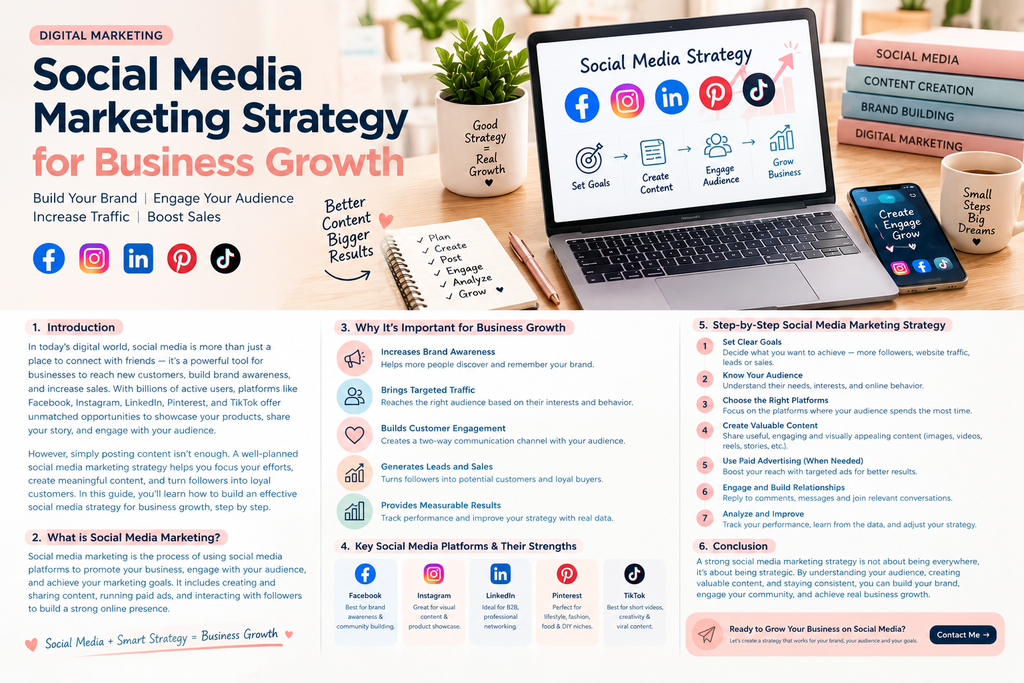
Social Media Marketing Strategy for Business Growth
Introduction
In today’s digital world, social media has become an essential part of business growth. Platforms such as Facebook, Instagram, LinkedIn, Pinterest, and TikTok allow businesses to connect with their target audiences, promote their products and services, and build strong online relationships.
However, simply creating social media accounts and publishing random posts is not enough. Businesses need a clear strategy to attract the right audience, create valuable content, increase engagement, and achieve meaningful results.
A well-planned social media marketing strategy helps businesses establish their brand identity, communicate with customers, and support long-term growth.
In this guide, we will explore the importance of social media marketing, the major platforms, and practical steps to develop an effective strategy for your business.
1. What Is Social Media Marketing?
Social media marketing is the process of using social media platforms to promote a business, build brand awareness, engage with an audience, and achieve marketing goals.
It includes creating content, managing business pages, interacting with followers, analyzing performance, and running paid advertising campaigns when appropriate.
For example, a clothing business can share product photographs, styling tips, customer feedback, and promotional offers on Instagram and Facebook to help potential customers discover its products.
An effective strategy combines creativity, consistency, audience understanding, and performance analysis.
2. Why Is Social Media Marketing Important for Business Growth?
Increase Brand Awareness
Social media helps introduce your business to people who may not know about your products or services. Consistent branding and useful content can help audiences recognize your business.
Reach Your Target Audience
Businesses can choose platforms and content formats that match their audiences’ interests and preferences.
Understanding your customers helps you create more relevant messages and marketing campaigns.
Build Customer Relationships
Responding to comments, answering questions, and communicating professionally can help businesses build trust and maintain relationships with customers.
Drive Website Traffic
Social media posts can direct interested users to your website, blog, product pages, or service pages.
Useful content and clear calls to action can encourage visitors to explore your business further.
Generate Leads and Sales
Businesses can use organic content and paid advertising to encourage inquiries, product discoveries, bookings, and purchases.
Results depend on the offer, audience, content quality, and overall customer experience.
3. Choose the Right Social Media Platforms
Every platform has different strengths. You do not need to use every platform at once.
Facebook can support business page management, community engagement, product promotion, and paid advertising through Meta’s advertising tools.
Suitable for: Local businesses, clothing stores, restaurants, and many service providers.
Instagram emphasizes visual content, including photographs, Reels, Stories, and product showcases.
Suitable for: Fashion, beauty, lifestyle, food, and visually focused brands.
LinkedIn is useful for professional networking, business-to-business marketing, industry insights, and professional service promotion.
Suitable for: Consultants, agencies, recruiters, and B2B companies.
Pinterest helps users discover ideas, inspiration, and useful resources through visual Pins.
Suitable for: Fashion, home decor, lifestyle brands, design, and content-driven businesses.
TikTok
TikTok focuses on short-form video content and can help brands demonstrate products, share educational videos, and communicate creatively.
Suitable for: Businesses whose audiences engage with short videos and trend-focused content.
Choose platforms based on your business goals, available resources, and audience behavior.
4. Set Clear Social Media Marketing Goals
Before creating content, decide what you want your strategy to achieve.
Common goals include:
- Increasing brand awareness.
- Growing relevant audience engagement.
- Driving website traffic.
- Generating qualified leads.
- Increasing product sales.
- Improving customer communication.
Make your goals specific and measurable whenever possible.
For example, instead of saying, “I want to grow my social media,” you could aim to increase relevant website visits over the next three months.
Track progress regularly and adjust your strategy according to the results.
5. Understand Your Target Audience
Understanding your audience is one of the most important parts of social media marketing.
Research the questions customers ask, the challenges they face, the products they need, and the content they find useful.
Consider factors such as location, relevant demographics, interests, buying behavior, and preferred content formats.
You can learn from customer conversations, page insights, website analytics, surveys, and competitor content.
Avoid assuming that every person in a broad audience has the same needs.
The better you understand your audience, the easier it becomes to create relevant content and communicate the value of your business.
6. Create Valuable and Engaging Content
Content is the foundation of a strong social media presence.
A balanced content strategy can include several types of posts.
Educational Content: Share tips, tutorials, answers to common questions, and practical advice.
Promotional Content: Introduce your products, services, special offers, or new collections.
Behind-the-Scenes Content: Show your creative process, business activities, or how your services work.
Engagement Content: Ask relevant questions, invite feedback, or encourage meaningful conversations.
Trust-Building Content: Share genuine customer reviews, testimonials with permission, and authentic examples of your work.
Use clear visuals, readable text, and a consistent brand style. Every post should provide a reason for your audience to stop, read, watch, or interact.
7. Build a Consistent Content Calendar
A content calendar helps you plan posts in advance and maintain a consistent publishing routine.
Start by choosing a manageable posting schedule that fits your time and resources.
For example, your weekly plan could include:
- Monday: An educational tip.
- Tuesday: A product or service showcase.
- Wednesday: A short video or Reel.
- Thursday: A frequently asked question.
- Friday: A business update or customer-focused post.
- Weekend: Community engagement or a useful recap.
This is only a sample schedule. Adjust it according to your audience, platform, and available resources.
Consistency does not mean posting as often as possible. It means maintaining a sustainable schedule and focusing on useful content.
8. Use Paid Advertising Strategically
Organic content can help build relationships, while paid advertising can extend your reach and support specific campaign objectives.
Platforms such as Meta Ads Manager provide tools for creating advertising campaigns based on goals such as awareness, traffic, leads, or sales.
Before launching an advertisement:
- Define your campaign objective.
- Identify the audience you want to reach.
- Prepare relevant images or videos.
- Write clear and accurate advertising copy.
- Set a realistic budget.
- Monitor results and improve your approach.
Paid advertising should support a clear business goal. Spending money does not guarantee leads or sales, so evaluate campaign performance carefully.
9. Measure Performance and Improve Your Strategy
Tracking results helps you understand what is working and what needs improvement.
Important metrics may include:
Reach: The number of people who saw your content.
Engagement: Interactions such as likes, comments, shares, and other platform-specific actions.
Click-Through Rate: The proportion of impressions that resulted in clicks, according to the selected metric.
Website Traffic: Visits generated from social media.
Leads: Inquiries or potential customers generated through your marketing activities.
Conversions: Desired actions, such as purchases, bookings, or completed forms.
Choose metrics that match your goals. For example, a brand awareness campaign and a lead generation campaign should not be judged using exactly the same criteria.
Review performance regularly, learn from audience responses, and make informed improvements.
10. Common Social Media Marketing Mistakes to Avoid
Businesses can weaken their strategy by making several common mistakes.
Avoid publishing without a clear plan, ignoring customer comments, using inconsistent branding, copying competitors without understanding your audience, and focusing only on follower numbers.
Do not rely on misleading claims or irrelevant trends simply to gain attention.
Instead, focus on authentic communication, valuable content, clear goals, and continuous learning.
Conclusion
A successful social media marketing strategy requires more than regular posting. It involves understanding your audience, choosing suitable platforms, creating valuable content, maintaining consistency, and measuring performance.
By combining organic content, meaningful engagement, and carefully planned paid campaigns, businesses can build a stronger online presence and support their long-term marketing goals.
Start with a clear plan, learn from your audience, and improve your strategy over time.
Need Help With Social Media Marketing?
Are you looking to build your brand, improve social media engagement, or promote your business online?
I provide digital marketing support, including social media marketing, Facebook and Meta Ads, SEO, content planning, and online brand promotion.
Let’s discuss your business goals and explore a marketing strategy that fits your needs.
Contact me to discuss your project and take the next step toward growing your business online.