
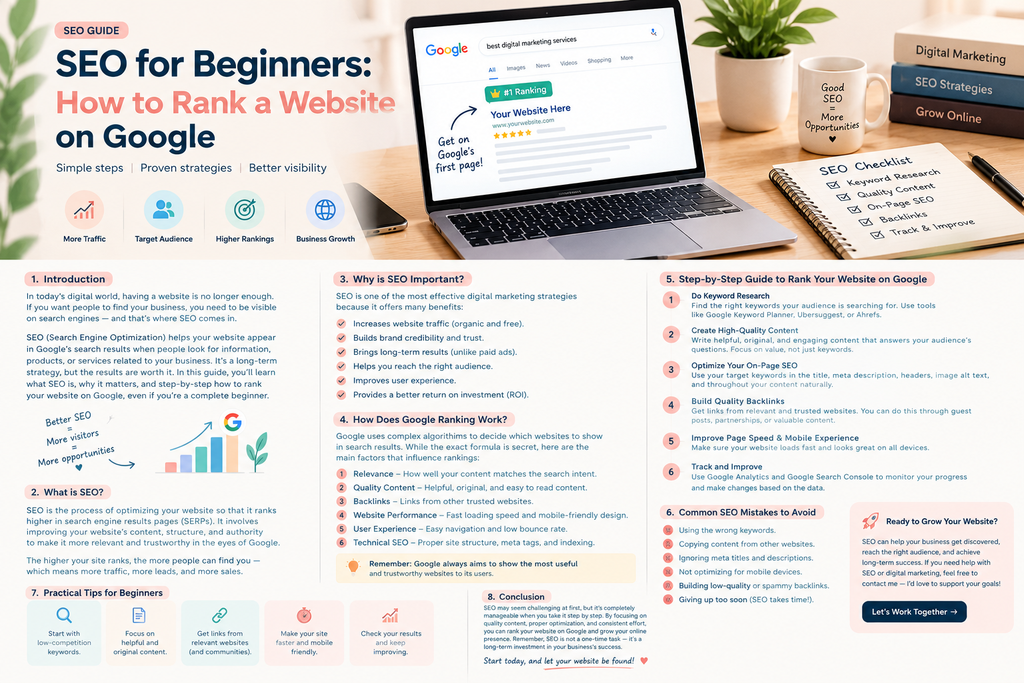
SEO for Beginners: How to Rank a Website on Google
Introduction
In today’s digital world, having a website is an important step toward building a successful online presence. However, simply creating a website is not enough. People need to discover your website when they search for information, products, or services online.
This is where Search Engine Optimization (SEO) becomes important.
SEO helps businesses improve their website’s visibility in search engine results and attract relevant visitors. Whether you own a small business, run an online store, or manage a professional portfolio website, understanding SEO can help you reach your target audience.
In this beginner-friendly guide, we will explain what SEO is, why it matters, how Google ranking works, and which practical steps you can take to improve your website’s search visibility.
1. What Is SEO?
SEO stands for Search Engine Optimization. It is the process of improving a website so that search engines can understand its content and users can find useful information more easily.
SEO involves several activities, including keyword research, content optimization, technical improvements, internal linking, and building your website’s credibility.
For example, imagine you offer digital marketing services. Someone searches Google for “digital marketing services for small businesses.” If your website contains helpful, relevant content about those services, it may have an opportunity to appear in the search results.
SEO does not guarantee a particular ranking. Instead, it helps search engines understand your website and can improve its chances of reaching the right audience.
2. Why Is SEO Important for Businesses?
SEO can support business growth in several ways.
Increase Organic Traffic
Organic traffic refers to visitors who reach your website through unpaid search results.
When your pages appear for relevant searches, people who are already interested in your topic may discover your business.
Build Trust and Credibility
A professional website with useful information, clear navigation, and accurate content can help establish credibility with visitors.
Strong search visibility can also help people discover your brand, although rankings alone do not guarantee trust.
Reach the Right Audience
Keyword research and search intent analysis help you understand what people are looking for.
By creating content that answers their questions, you can attract visitors whose needs match your services.
Support Long-Term Growth
SEO can continue bringing relevant visitors after content is published and optimized. However, rankings and traffic can change, so ongoing monitoring and improvement are important.
Improve User Experience
Good SEO practices often encourage faster pages, mobile-friendly design, helpful navigation, and clear content. These improvements can benefit visitors as well as search engines.
3. How Does Google Ranking Work?
Google uses automated systems to discover, understand, and organize web pages. Several important processes are involved.
Crawling
Google uses automated programs called crawlers to discover pages and follow links across the web.
Indexing
After discovering a page, Google may analyze its content and store information about it in its index. Not every discovered page is necessarily indexed.
Ranking
When someone performs a search, Google’s systems evaluate relevant indexed pages and determine which results are most useful for that particular query.
Several factors can influence visibility, including:
- Relevance to the user’s search.
- Quality and usefulness of the content.
- Page experience and usability.
- Website accessibility and technical structure.
- The reputation and credibility of the content and website.
There is no single trick that guarantees a first-page ranking. The goal is to create helpful content and make your website easy for users and search engines to understand.
4. What Is Keyword Research?
Keyword research is the process of discovering the words and phrases people use when searching online.
Choosing relevant keywords helps you understand your audience and plan useful website content.
For example, a digital marketing portfolio website might target phrases such as:
- Digital marketing services
- SEO services for small businesses
- Facebook Ads management
- Social media marketing strategy
- Website SEO optimization
These are examples, not verified search-volume rankings. Research each keyword before deciding which ones to target.
Understand Search Intent
Search intent means the reason behind a search.
Common types include:
Informational Intent: The user wants to learn something, such as “What is SEO?”
Commercial Investigation: The user is comparing options, such as “best SEO services for small businesses.”
Transactional Intent: The user is ready to take action, such as hiring an SEO specialist.
Navigational Intent: The user wants to find a particular website or brand.
Understanding search intent helps you create the right type of page for each keyword.
5. How to Rank Your Website on Google: Step by Step
Step 1: Find Relevant Keywords
Start by identifying the topics and phrases your target audience searches for.
You can use Google Search suggestions, Google Trends, Google Keyword Planner, and other keyword research tools to explore ideas.
Choose keywords that are relevant to your services and that you can address with genuinely useful content.
Step 2: Create High-Quality Content
Write content that answers the reader’s questions clearly and accurately.
Organize your article with a descriptive title, useful headings, short paragraphs, and relevant examples.
Avoid copying articles from other websites or repeating keywords unnecessarily. Original, helpful content provides more value than content written only to manipulate search rankings.
Step 3: Optimize Your Page Title
Your page title should clearly explain what the page is about.
For example:
“SEO for Beginners: How to Rank a Website on Google”
A descriptive title helps visitors and search engines understand the topic of your page.
Step 4: Write a Useful Meta Description
A meta description is a short summary that can be used to describe a page in search results.
Example:
“Learn SEO basics, keyword research, on-page optimization, and practical strategies to improve your website’s visibility on Google.”
Google may choose a different snippet from the page content, so writing a meta description does not guarantee that the exact text will appear in search results.
Step 5: Improve On-Page SEO
On-page SEO means optimizing elements within your web pages.
Important practices include:
- Using a clear page title.
- Organizing content with descriptive headings.
- Including relevant keywords naturally.
- Writing helpful image alt text.
- Linking to related pages on your website.
- Using readable URLs.
- Providing useful, original information.
Keep your content natural and focused on helping readers rather than forcing keywords into every paragraph.
Step 6: Make Your Website Mobile-Friendly
Many people browse websites on smartphones and tablets.
Use a responsive WordPress theme, readable text, clear menus, and appropriately sized images.
Test your pages on different screen sizes to make sure visitors can navigate and read your content comfortably.
Step 7: Improve Website Performance
A slow or difficult-to-use website can frustrate visitors.
Consider compressing large images, using reliable hosting, limiting unnecessary plugins, and keeping your WordPress installation updated.
Google PageSpeed Insights can help you identify performance issues and opportunities for improvement.
Step 8: Use Internal Links
Internal links connect one page of your website to another.
For example, your SEO guide can link to your digital marketing services page or a related article about keyword research.
Useful internal links help visitors explore related information and help search engines discover your pages.
Step 9: Build Credibility Naturally
Create content worth referencing and build genuine relationships with relevant websites, professionals, and communities.
When other reputable websites link to your content naturally, those links can help search engines understand your site’s relevance and reputation.
Avoid buying spammy links or participating in link schemes designed to manipulate rankings.
Step 10: Monitor Your SEO Performance
Use Google Search Console to review search queries, impressions, clicks, indexing information, and other available reports.
Google Analytics can help you understand how visitors interact with your website.
Review the data regularly and improve pages based on what you learn. SEO usually takes time, and results vary by website, competition, and industry.
6. Common SEO Mistakes Beginners Should Avoid
Beginners sometimes focus on quick results instead of building a useful website.
Avoid these mistakes:
- Stuffing keywords unnaturally into content.
- Copying content from other websites.
- Publishing thin or unhelpful articles.
- Ignoring mobile usability.
- Using misleading page titles.
- Forgetting internal links.
- Buying low-quality backlinks.
- Expecting guaranteed rankings within a few days.
- Ignoring technical problems that prevent pages from being crawled or indexed.
A sustainable SEO strategy focuses on relevance, quality, accessibility, and the needs of real visitors.
7. Practical SEO Tips for WordPress Websites
If you use WordPress, you can take several practical steps to improve your website’s SEO.
Choose a responsive theme and keep your website structure simple.
Create clear categories for related blog posts. Use descriptive URLs, add relevant featured images, and write meaningful alt text for informative images.
You may use an SEO plugin such as Yoast SEO or Rank Math to manage page titles, meta descriptions, and other supported SEO settings.
Connect your website to Google Search Console to monitor search performance and indexing information.
Most importantly, publish useful articles consistently and update older content when necessary. Avoid publishing low-quality articles simply to increase the number of posts on your website.
Conclusion
SEO is an important part of building a strong online presence. By understanding keyword research, creating helpful content, improving on-page SEO, making your website mobile-friendly, and monitoring performance, you can build a solid foundation for long-term search visibility.
Remember that Google rankings are not guaranteed, and SEO results do not happen overnight. Focus on providing genuine value, understanding your audience, and improving your website over time.
Whether you are a business owner, blogger, or digital marketer, learning SEO can help you make better decisions and create a more useful website.
Need Help With SEO and Digital Marketing?
Are you looking to improve your website’s search visibility, create better content, or build a stronger online presence?
I provide digital marketing support, including SEO, keyword research, social media marketing, Facebook and Meta Ads, and content strategy.
Let’s discuss your business goals and explore how a suitable digital marketing strategy can support your online growth.
Contact me to discuss your project and take the next step toward growing your business online.