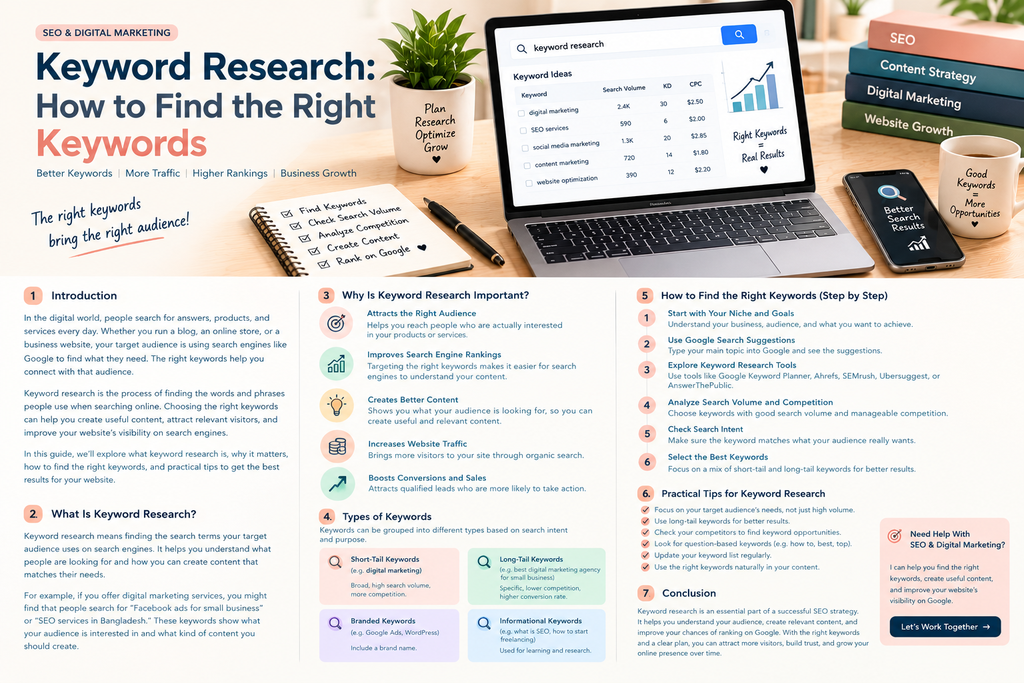
Introduction
In the world of digital marketing, understanding what people search for online is essential for building a successful website. Whether you run a blog, an online store, or a digital marketing agency, choosing the right keywords can help you connect with your target audience.
Keyword research is one of the most important parts of Search Engine Optimization (SEO). It helps you discover the words and phrases people use when looking for information, products, or services on search engines like Google.
By understanding your audience’s search behavior, you can create useful content, improve your website’s visibility, and attract visitors who are genuinely interested in what you offer.
In this guide, you will learn what keyword research is, why it matters, which types of keywords you should know, and how to find the right keywords for your website.
1. What Is Keyword Research?
Keyword research is the process of identifying and analyzing the words and phrases people enter into search engines when looking for information, products, or services.
It helps digital marketers understand what their target audience wants and create content that matches those needs.
For example, if you offer digital marketing services, your potential keywords might include:
- Digital marketing agency
- SEO services for small businesses
- Facebook Ads management
- Social media marketing services
- Website SEO optimization
These keywords can help you plan relevant website pages and blog posts. However, you should research each keyword before choosing it for your SEO strategy.
2. Why Is Keyword Research Important?
Keyword research helps you make informed decisions about your website content and SEO strategy.
Attract the Right Audience
Relevant keywords can help you reach people who are actively searching for information related to your business.
Improve Search Visibility
Creating useful content that matches search intent can help search engines understand your pages and consider them for relevant search results.
Discover Content Ideas
Keyword research reveals common questions, problems, and topics that your audience wants to understand.
Understand Your Competition
Researching competing pages helps you identify what type of content already exists and how you could provide something more useful.
Support Business Growth
When your website attracts relevant visitors, you may have more opportunities to generate inquiries, build relationships, and gain customers. Results depend on your content, offer, audience, and competition.
3. Types of Keywords
Understanding different keyword types helps you build a balanced SEO strategy.
Short-Tail Keywords
Short-tail keywords are broad search phrases that usually contain one or two words.
Examples:
- Digital marketing
- SEO services
- Online advertising
These keywords can cover broad topics and may have strong competition. Their search intent can also be less specific.
Long-Tail Keywords
Long-tail keywords are more specific phrases that often reveal a clearer user need.
Examples:
- Digital marketing services for small businesses
- Affordable SEO services for local businesses
- Facebook Ads management for clothing stores
Long-tail keywords can help you create focused content for a particular audience. They do not automatically guarantee higher rankings or conversions.
Branded Keywords
Branded keywords contain the name of a particular business, product, or brand.
Examples:
- WordPress
- Google Analytics
- A company’s name followed by “services”
These keywords are useful when people want to learn about or find a particular brand.
Informational Keywords
Informational keywords indicate that someone wants to learn something.
Examples:
- What is SEO?
- How does Facebook advertising work?
- How to find keywords for a website
These keywords are often suitable for educational blog posts and beginner guides.
Commercial Keywords
Commercial keywords suggest that someone is researching or comparing options before making a decision.
Examples:
- Best SEO tools for beginners
- Digital marketing agency comparison
- Best keyword research tools
These searches can be useful for comparison articles and service-related content.
4. How to Find the Right Keywords Step by Step
Step 1: Understand Your Business and Audience
Start by identifying your services, business goals, and ideal customers.
For a digital marketing portfolio, your main topics might include SEO, Meta Ads, social media marketing, content marketing, and website optimization.
Ask yourself:
- Who is my target audience?
- What problems do they want to solve?
- What services are they searching for?
- What questions might they ask before hiring a digital marketer?
Your answers will help you generate relevant keyword ideas.
Step 2: Use Google Search Suggestions
Open Google and begin typing a phrase related to your business.
For example, type “SEO services for” and review the suggestions that appear.
You can also examine related searches and the questions shown in search results.
These suggestions provide ideas about how people phrase their searches. They should be treated as research clues rather than proof of exact search volume.
Step 3: Use Keyword Research Tools
Keyword research tools can help you investigate search demand, competition, and related phrases.
Useful options include:
- Google Keyword Planner
- Google Trends
- Google Search Console
- Ahrefs
- Semrush
- Ubersuggest
Some tools require an account or paid subscription. The metrics and available features vary between tools.
Use several sources when appropriate, and do not assume every tool reports identical numbers.
Step 4: Analyze Search Volume
Search volume estimates how frequently a keyword is searched over a particular period, depending on the tool.
A keyword with higher search volume may offer greater potential reach, but it can also be highly competitive or too broad for your website.
For a new portfolio website, specific keywords with relevant search intent may be more useful than targeting only broad, popular phrases.
Step 5: Check Keyword Difficulty
Keyword Difficulty (KD) is a tool-specific estimate of how challenging it may be to rank for a keyword.
Different tools calculate this metric differently, so compare scores within the same tool whenever possible.
Review the actual Google search results, the quality of competing pages, and whether your website can create a useful, competitive resource.
Do not choose keywords based on difficulty scores alone.
Step 6: Understand Search Intent
Search intent is the reason behind a search.
For example:
- “What is keyword research?” indicates informational intent.
- “Best SEO tools for beginners” indicates comparison or commercial investigation.
- “Hire an SEO specialist” suggests a service-focused intent.
Create content that matches what searchers want. A beginner’s guide is usually more suitable for an informational query than a page focused only on selling services.
Step 7: Create a Keyword List
Organize your researched keywords in a spreadsheet.
Useful columns include:
- Keyword
- Search Volume (SV)
- Keyword Difficulty (KD)
- Cost Per Click (CPC)
- Search Intent
- Target Page
- Priority
CPC is an advertising metric and should not be treated as a direct measure of organic SEO value.
Your spreadsheet will help you compare opportunities and decide which topics to address first.
Step 8: Select Keywords for Your Content
Choose one primary topic for each page and add related terms naturally where they help explain the subject.
For example, an article titled “SEO for Beginners: How to Rank a Website on Google” could also cover keyword research, on-page SEO, search intent, and website optimization.
Avoid creating many nearly identical pages simply to target small variations of the same keyword.
5. How to Use Keywords in Your Website Content
After selecting your keywords, use them naturally in relevant places.
Page Title
Write a clear title that accurately describes the page.
Example: “Keyword Research: How to Find the Right Keywords.”
Headings
Use descriptive headings to organize your content and help readers find the information they need.
URL Slug
Use a short, readable URL that describes the page.
Example: keyword-research-guide
Meta Description
Write a concise summary of the page that encourages relevant searchers to understand what they can learn.
Example:
“Learn how to research keywords, analyze search intent, compare SEO metrics, and choose the right keywords for your website.”
Google may generate a different search snippet, so a meta description does not guarantee that exact text will appear.
Main Content and Image Alt Text
Include relevant phrases naturally in your article and write descriptive alt text for informative images.
Avoid keyword stuffing, which can make content difficult to read and may violate search engine spam policies.
6. Common Keyword Research Mistakes to Avoid
Beginners should avoid these common mistakes:
- Choosing keywords only because they have high search volume.
- Ignoring the needs and intent of the target audience.
- Relying entirely on one keyword tool.
- Targeting highly competitive terms without evaluating the results.
- Repeating the same keyword unnaturally.
- Copying competitors instead of creating original content.
- Ignoring keyword performance after publication.
Effective keyword research requires analysis, useful content, and continuous improvement.
7. Practical Tips for Beginners
If you are starting SEO for a new WordPress website, keep your strategy simple.
First, focus on the services and topics most relevant to your website. Research specific keywords, examine the current search results, and create helpful articles that answer genuine questions.
Use Google Search Console after your pages become discoverable to review impressions, clicks, and search queries.
Update your keyword spreadsheet as you learn more about your audience and the performance of your content.
Remember that keyword research is not just about finding popular words. It is about understanding people and creating content that genuinely helps them.
Conclusion
Keyword research is a fundamental part of an effective SEO strategy. It helps you understand your audience, discover content opportunities, analyze competition, and organize your website around relevant topics.
By combining keyword research tools with search intent analysis and high-quality content, you can build a stronger foundation for your website’s organic visibility.
Start with a clear goal, research carefully, create useful content, and improve your strategy over time. SEO takes patience, and no keyword can guarantee a particular Google ranking.
Need Help With SEO and Keyword Research?
Are you looking to improve your website’s search visibility, find relevant keywords, or develop a content strategy for your business?
I provide digital marketing support, including SEO, keyword research, social media marketing, Facebook and Meta Ads, and content planning.
Let’s discuss your business goals and explore a digital marketing strategy that fits your needs.
Contact me to discuss your project and take the next step toward growing your online presence.